
This past week, a new flock of Wally Birds flew in from Bur Oak Pottery. Each hand crafted bird is a one of a kind creation, and each has a distinct personality.

Wally Birds were first created by The Martin Brothers Pottery in England in the late 1800's/early 1900's. Each bird had a removable head and the body that could be used as a small storage container. Originally said to be tobacco jars, Wally Birds were named after their creator, Wallace Martin. Today, original Wally Birds command a premium on the auction market.

Our Wally Birds are inspired by the originals and are created by husband and wife potters, Ed and Laura Klein of Bur Oak Pottery. To begin a bird, Laura throws two small pots (one for the head and a second for the body) and also a base in on a potter's wheel. Ed Klein then takes these pots and transforms them into fantastic birds by hand, adding legs, beaks, wings and unique personalities to each creation. After drying and undergoing a bisque firing, the birds are glazed with touches of color and put into a wood fired kiln.

The final firing of the stoneware takes a complete day of constant supervision. Because the kiln is heated by a wood burning fire, careful attention must be paid to the amount of flame and heat that is produced. Salt is thrown into the kiln at the end of the firing which vaporizes in the heat and reacts to the clay, producing the unique "salt glaze" surface over the pieces. Placement inside the kiln is critical because there are areas which are hotter than others, and ash from the wood fire goes up into the kiln, landing on the pieces as the firing progresses. At the end of the firing cycle, the fire is extinguished, the kiln is wrapped in fire proof blankets, and is allowed to cool over several days. Each bird jar is finished with a hand lathed painted wooden base, just like the originals.
Because they take so much time and imagination to create, we rarely have more than a couple birds in our showroom at any one time. Each of these pieces is a one-of-a-kind creation. Our recent flock includes:

Boris (picture top, right)- This bird bears a distinct resemblance to Boris Karloff.
Evil Grin Bird (pictured above, left) - We know what a cat looks like when it eats a canary, but this bird has definitely been getting the better of the cat!
Frowning Bird (pictured above, right) - Our little friend got up on the wrong side of the nest and doesn't care who knows it.
Opera Bird (pictured to the left) - A happy, singing bird who is trying to cheer up his companions.

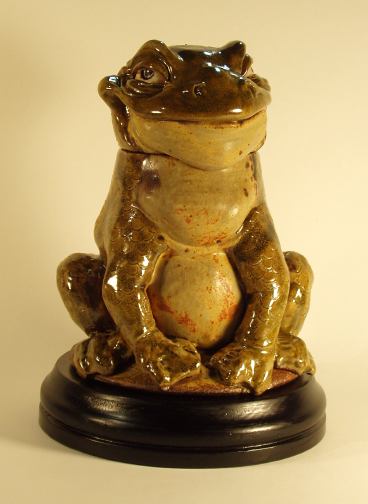
We also received two unusual jars with the birds, a Frog Jar and a Toad Jar. Like the birds, their heads remove for secret storage of treasured objects. The Frog (pictured left) has a shiny overall glaze and looks like he has been happily spending time in a nearby pond.

The Toad (pictured right) has a wonderfully bumpy body.

 Over the past week, Bill has completed cutting and fitting all the pieces for the Oz window. He has also finished all the painting and firing, so it's ready to start assembling. Above, you can see the window laying on a light table - the window is wider than the table, so the entire image isn't lit. The shadow running down the center of the window is a support bar in the table.
 In the photo to the right, Bill is hand painting the face of the Hungry Tiger. When painting and firing on glass, the glass chosen must first be tested by firing a sample piece in the kiln to make sure the color and transparency does not change. You can see in the photo that Bill has blocked in the areas he wants to paint, then has to go back in to add color, texture and shading with the glass paints. This process takes a lot of skill and patience. The photo below shows the completed face.
 So what has Irwin been doing all this time? Well, he was soldering the Renoir By the Sea window and then he has been working on a small lamp for a local client - more on those projects in later postings!






 Posts
Posts


